Meet
Arrive at a church home, where your local community comes together.
 IMMANUEL UNITEDMember area
A generous meal. Familiar faces.
Room for friendship to grow.

01 / Visit
Our gathering is a substantial brunch in a church home. The meal itself is the service.
Your host furnishes and prepares the meal. Members generally bring nothing—simply arrive, greet your friends, and enjoy your time together.
Membership availabilityArrive at a church home, where your local community comes together.
Catch up on life. Share a laugh. Encourage one another as friends.
Share a generous brunch, settle in, and enjoy being together.
Gathering dates and visitor arrangements will appear here when available.
02 / About Immanuel
We gather as friends in a home, around a meal prepared with care.
Our local communities make room for conversation, encouragement, laughter, and the ordinary things of life. There is no required topic of conversation. Faith may be part of it; so may everything else friends need to talk about.
Our vision is a multicultural community whose members know one another and enjoy life together.
The shared meal
is our worship.
Doctrine
Ten distinctive stances.
This is not an exhaustive account of our beliefs. These are convictions we consider particularly important, including those that distinguish us from several mainstream Christian traditions.
Immanuel United Church teaches anti-sectarianism. This doctrine draws particularly from Jesus’s high-priestly prayer in the Garden of Gethsemane and the Apostle Paul’s teaching that sectarianism is carnal.
Accordingly, the church does not encourage denominational identity. It encourages the oneness in Jesus of all believers. It holds a catholic mindset in the original sense of catholic: the one, universal church.
Immanuel United Church therefore denies and rebukes the idea that any particular denomination is exceptional, uniquely privileged, or constitutes a church separate from what Jesus calls his Church. The church affirms one Church, both visible and invisible.
Immanuel United Church gathers to feast and fellowship. Our ordinary gathering is a generous shared meal in a church home, where believers meet as friends, catch up on life, encourage one another, unwind and enjoy one another’s company. The feast itself is our shared service.
We uphold a non-liturgical form of gathering. We do not dismiss every liturgical expression as an invalid expression of faith; we reject making such expressions the prescribed program or obligation of our ordinary assembly. Our gatherings have no scheduled sermon, congregational song service, corporate prayer, or worship leader directing a religious program. Neither a host nor a priest has a prescribed speaking or liturgical role. Friendship, hospitality, and recreation give the gathering its form.
We draw inspiration from the early believers’ fellowship and meals in their homes. We understand the call to gather as a call to sustain one another in love and faithful community. Paul’s confrontation with Peter over his withdrawal from eating with Gentile believers shows how seriously fellowship across ethnic boundaries matters to the gospel. Our shared table must express that fellowship without ethnic preference or exclusion.
We describe this aspiration as an ante-Catholic communion: our own term for seeking the simplicity of early Christian fellowship before the later institutional and liturgical forms from which we distinguish our practice.
Teaching remains freely available beyond the gathering. The church maintains a public online teaching library, accessible without charge to both members and non-members, with written teachings, audio or podcasts, videos, concordances, a biblical encyclopedia and other study resources as these are developed. Members may study independently, bring questions to their host or an appropriate church teacher, and discuss faith with friends throughout the week or over a meal. Such conversation does not become a sermon addressed to the assembled group. We gather to enjoy friendship with people whose conduct honors Jesus, without performative religious obligations.
Immanuel United Church vehemently denies a sacred–secular dichotomy. Scripture declares that the earth and everything in it belong to the Lord (Psalm 24:1; quoted in 1 Corinthians 10:26). In the post-resurrection Revelation, the One seated on the throne declares, “Behold, I am making all things new” (Revelation 21:5). Therefore, the church does not divide faithful life into a sacred sphere and a secular sphere. Everything is sacred.
No faithful vocation, field of learning, ordinary relationship, or legitimate work lies outside the spiritual life. What a believer undertakes in faith and obedience to Jesus is spiritual service. English, medicine, cooking, education, commerce, friendship, and every other area of life may be approached through faith; none becomes religious only by being placed inside a church building or labeled a religious subject.
Anti-dualism does not mean that every act is righteous merely because a believer performs it. It means that no area of faithful life is inherently profane or spiritually irrelevant, and that the believer is to apply faith to the whole of life.
Closely related to anti-dualism is the doctrine of Worship as Service. Romans 12:1 is the central expression: Paul calls believers to offer their embodied lives to God, using a phrase translated variously as “true and proper worship,” “spiritual worship,” “spiritual service,” or “reasonable service.” Worship is therefore not confined to a scheduled religious program; it is the offering of one’s actual life and work to God.
Colossians 3:23–24 instructs believers to do their work heartily as for the Lord. James 1:27 identifies pure religion with practical care for people in distress, and Jesus teaches that service rendered to “the least of these” is rendered to him (Matthew 25:40). These passages support a theology in which serving people through one’s calling is service to Jesus and therefore worship.
A physician who heals the sick performs worship through that healing work. A merchant who brings accessible or discounted organic produce and groceries to an underserved community performs spiritual service through the faithful use of that calling. The same principle applies to every legitimate vocation and to ordinary relationships: doing the real work of Jesus for others is worship.
For this reason, Immanuel United Church does not define showing up on Sunday to sing songs, hear a sermon, or deliver a sermon as a “worship service.” Such activities do not become worship merely because they occur in a church setting. Worship is faithful service in everyday callings and relationships—the embodied work of Jesus carried into the world.
Anti-dualism answers where the spiritual life occurs: everywhere, because all faithful life belongs to the Lord. Worship as Service answers what worship looks like: offering one’s life, vocation, relationships, and practical service to God by doing the work of Jesus for others.
This doctrine is the cardinal creed governing everything Immanuel United Church does:
“Allah Yeshua Ben Yosef Jesus is Schekeinah Yahweh incarnate.”
Immanuel United Church rejects every doctrine, diagram, formula, or interpretation that conflicts with this truth.
Yeshua Ben Yosef Jesus spoke plainly about his divinity and his oneness with Yahweh. When he declared, “I and the Father are one” (John 10:30), the church understands one to mean one and the same God and person—not merely two beings who are “of one accord.”
The immediate response in John 10 confirms the gravity of his claim. His opponents picked up stones. When Jesus asked which good work justified stoning him, they answered that the issue was blasphemy: he was a man making himself God (John 10:31–33). Jesus did not withdraw the claim. He challenged their judgment, appealed to Scripture and his works, again described the Father as being in him and himself as being in the Father, and escaped when they again sought to arrest him (John 10:34–39).
Jesus later told Philip, “Whoever has seen me has seen the Father,” and continued, “I am in the Father and the Father is in me” (John 14:9–11). Thomas addressed the risen Jesus as “My Lord and my God,” and Jesus accepted his confession (John 20:28–29). The church therefore refuses any interpretation that makes Jesus merely a representative of God, a lesser divine being, or one divine person standing apart from another.
Jesus promised that he would not leave his disciples orphaned but would come to them (John 14:16–18). He said that his departure was necessary and that, when he went, he would send the Helper (John 16:7). After the resurrection he promised, “I am with you always, to the end of the age” (Matthew 28:20). After his ascension, the promised Holy Spirit descended at Pentecost (Acts 1:4–9; 2:1–4).
Scripture speaks of the same indwelling Spirit as both “the Spirit of God” and “the Spirit of Christ” (Romans 8:9), and also as “the Spirit of his Son” (Galatians 4:6). Immanuel United Church therefore confesses that the Holy Spirit of Yahweh is the Holy Spirit of Jesus. This is not the activity of a divine being separate from Jesus: it is Jesus present with and within his people.
There is mystery in how the incarnate Jesus could ascend and send his Spirit, but there is no uncertainty in the church’s confession: Yeshua Ben Yosef Jesus is Yahweh revealed in flesh, and the Holy Spirit is his Spirit.
A familiar triangular formula, commonly called the Shield of the Trinity or Scutum Fidei, places the Father, the Son and the Holy Spirit at separate outer points. It says that each “is God,” while also saying that the Father “is not” the Son, the Son “is not” the Spirit, and the Spirit “is not” the Father.
Immanuel United Church rejects this formula as blatant Gnostic heresy because its “is not” propositions divide the identity of Yahweh and contradict the oneness confessed above.
Immanuel United Church does not use Gnosticism as the name of one bounded religion, institution or historical sect. It names a nebulous and intentionally duplicitous philosophical set of beliefs that can inhabit many religions and traditions. A belief system is Gnostic when it adopts the defining principles of that philosophy.
The church identifies at least two central Gnostic tenets:
1. that any path, or many paths, lead to God; and 2. that special or hidden knowledge is necessary for protection, survival, ascent or access to power.
The church reads Genesis 3 as the first biblical appearance of this Gnostic pattern. The serpent presents himself as possessing privileged knowledge about Eve’s true state of affairs, Yahweh’s motives and the power available to her. He portrays that special knowledge as necessary to overcome her limitation and promises that her eyes will be opened and that she will become like God.
Immanuel United Church maintains and vigorously enforces the Accords of Anathema: cardinal membership agreements that every applicant must affirm before becoming an approved, registered member. Continued membership requires adherence to those agreements.
Following the discipline described in 1 Corinthians 5:1–13, the church does not tolerate within its communities cardinal wrongdoing or conduct fundamentally antithetical to Jesus. The full Accords are addressed through the membership process.
Immanuel United Church wholly rejects the popular doctrine that Christians or church members are required to tithe to a church. The church will not impose a ten-percent levy, a temple tax, compulsory giving, or any equivalent religious financial obligation upon its members.
Matthew 17:24–27 provides the central statement. When Jesus and his disciples arrived in Capernaum, the collectors of the two-drachma temple tax approached Peter and asked whether his teacher paid it. Peter answered yes. When Peter entered the house, Jesus spoke first and asked him from whom earthly kings collect duties and taxes: their own children or others. Peter answered that they collect from others. Jesus therefore declared that the children are free or exempt.
Jesus nevertheless instructed Peter to pay for them both from the coin found in the fish—not because the tax bound the sons of the Kingdom, but expressly to avoid giving offense. The payment was a voluntary accommodation by those whom Jesus had already declared free, not an acknowledgment of continuing religious liability.
The two-drachma temple assessment operated within the tithing-system context of Judaism: the old-covenant structure of compulsory financial support for the temple and its religious order. Immanuel United Church therefore treats the temple tax as a form and expression of that tithing system, not as a category that can be isolated from it to preserve mandatory Christian tithing. Jesus’s declaration establishes the controlling principle: the sons of the Kingdom are free and are not subjects from whom Yahweh exacts such a religious levy. The temple’s compulsory financial system belongs to the order superseded by Jesus’s authority and by the new covenant established in his blood (Luke 22:20; Hebrews 7:11–12; 8:13).
The church distinguishes compulsory tithing from voluntary generosity. Under the new covenant, giving is freely determined by the giver rather than assessed by the church. Paul instructs each person to give what that person has decided in the heart, neither reluctantly nor under compulsion (2 Corinthians 9:7). Even when organizing a collection for believers in need, Paul directs people to set aside an amount in keeping with their income rather than prescribing a universal tithe (1 Corinthians 16:1–2).
Immanuel United Church may receive voluntary gifts and may invite members to support particular needs, but it will not teach that paying a tithe is a condition of faithfulness, membership, divine favor, or belonging in Jesus. No member owes the church a fixed percentage of income.
Immanuel United Church distinguishes affection for one’s country from idolatrous nationalism. We do not condemn appreciating, supporting, serving, or loving one’s country. We abhor the elevation of any nation, government, flag, military, or national cause above moral judgment and faithful obedience to Jesus.
No nation is beyond criticism. No act becomes righteous merely because one’s own country commits it. No believer is required to defend, excuse, or support conduct that contradicts the teachings and character of Jesus. Whenever national loyalty conflicts with allegiance to Jesus, allegiance to Jesus must prevail.
This doctrine applies equally to the United States, Israel, and every other nation. No earthly nation possesses a divine exemption from judgment, and no government is entitled to the unquestioning allegiance that belongs to Yahweh alone.
Immanuel United Church rejects bibliolatry: treating the Bible as an autonomous, self-interpreting or living authority; treating mastery of its text as mastery of truth; or using the book as a substitute for the living guidance of Jesus through his Holy Spirit. Jesus is Lord. The Holy Spirit—not the Bible—is the church’s guide into truth.
Before his crucifixion, Jesus told his disciples that he still had more to say than they could then bear. He promised that when the Spirit of truth came, the Spirit would guide them into all truth. The Spirit would speak what he heard, disclose what was to come, glorify Jesus, and receive from Jesus what he would make known to them. Jesus then declared that everything belonging to the Father is his (John 16:12–15).
In the same final discourse, Jesus said that the Holy Spirit, sent in his name, would teach the disciples all things and remind them of everything he had said (John 14:25–26). These promises assign the work of teaching, revealing, reminding and guiding into truth to the Holy Spirit. In continuity with the church’s confession of the oneness of Yeshua Ben Yosef Jesus, the Spirit who performs this work is the Spirit of Jesus present with and within his people.
Jesus warned people who studied the Scriptures diligently because they believed that life was possessed within the texts themselves. He told them that those Scriptures testified about him, yet they refused to come to him to receive life. He further said that if they truly believed Moses, they would believe Jesus, because Moses wrote about him (John 5:39–47). Scriptural expertise therefore does not itself produce recognition of Jesus, possession of truth or spiritual life. A person may know the words, arguments and textual traditions extensively while completely missing the one to whom they point.
Immanuel United Church acknowledges Paul’s teaching that Scripture is God-breathed and useful for teaching, rebuke, correction and training in righteousness (2 Timothy 3:14–17). Useful does not mean that Scripture replaces the Holy Spirit, interprets itself, or independently imparts truth. Scripture is a valuable witness and instrument; the Holy Spirit is the living teacher who enables people to perceive, understand and receive the truth to which Scripture bears witness. As Paul also writes concerning new-covenant ministry, competence comes from God: the letter kills, but the Spirit gives life (2 Corinthians 3:4–6).
Truth does not originate in a book. Truth is revealed in Yeshua Ben Yosef Jesus and made known by his Holy Spirit. The Bible contains and preserves testimony to that truth, but no one can find, possess or rightly wield that truth through textual study, intellectual effort, proof-texting or argument apart from the Holy Spirit.
The church therefore refuses to place the Bible above Jesus, beside Jesus, or in the place assigned by Jesus to his Spirit. It rejects the use of Scripture as an idol, a weapon of intellectual domination, or a means of proving oneself righteous while remaining deaf to the Spirit. Immanuel United Church reads and receives Scripture under the living guidance of the Holy Spirit, who alone guides the church into all truth.
Immanuel United Church declares Calvinism a complete heresy. The church rejects it in all its forms and identifies its system of salvation and damnation as satanic fatalism: a theological structure that attributes to Yahweh the eternal selection of some people for saving grace while withholding that grace from others, then treats the resulting destinies as the expression of divine sovereignty.
Whatever distinctions Calvinists make among themselves, Immanuel United Church rejects every formulation in which saving grace is eternally withheld from some people by divine decree, the saving purpose of Jesus’s death is restricted to a predetermined elect, grace is made irresistible, or human destiny is fixed in a manner that denies a genuine human response to Yahweh. Such doctrines contradict the revelation that Yahweh desires all people to be saved (1 Timothy 2:3–6), does not desire anyone to perish (2 Peter 3:9), provided atonement for the whole world (1 John 2:1–2), and can be resisted by people whom Jesus truly desired to gather (Matthew 23:37).
Under the church’s philosophical rather than genealogical definition of Gnosticism, Calvinism is a Gnostic belief system that arose within Christian theology. It divides humanity into a concealed spiritual caste of the elect and the reprobate or passed-over, makes salvation a privilege intentionally unavailable to others, and offers adherents a theological apparatus through which they claim knowledge of this otherwise hidden decree.
This system produces division and is rooted in profound spiritual arrogance: people are invited to understand themselves as the specially chosen recipients of irresistible grace while regarding others as people from whom Yahweh deliberately withheld the only grace that could save them. Immanuel United Church judges that picture of Yahweh to be antithetical to Jesus and destructive to human responsibility, humility, love and the unity of the Church.
The church will not detach Calvinist doctrine from John Calvin’s documented participation in the prosecution and execution of the theological dissenter Michael Servetus. Years before Servetus’s death, Calvin wrote that if Servetus came to Geneva and Calvin’s authority had effect, he would not permit Servetus to leave alive. Calvin later furnished material that helped secure proceedings against Servetus, instigated his arrest in Geneva, prosecuted the case, approved the death sentence and sought beheading rather than burning as the method of execution. The Geneva civil council imposed the sentence, but that fact does not erase Calvin’s purposeful participation.
Immanuel United Church therefore holds John Calvin morally responsible for murderous religious persecution. It refuses to honor him as a Christian teacher or to excuse his conduct as merely an error of his century. Killing a theological opponent is not a defense of Jesus, and a theology advanced through coercion and death bears fruit fundamentally opposed to him.
The rejection of Calvinism is not merely an academic disagreement. The Accords of Anathema will make adherence to or promotion of Calvinism incompatible with approved membership in Immanuel United Church. Calvinist teaching may not be preached, organized, defended or propagated within the church’s communities. The church’s public language will remain controlled and formal, but its boundary will be unequivocal.
Our primary emblem
Iconography
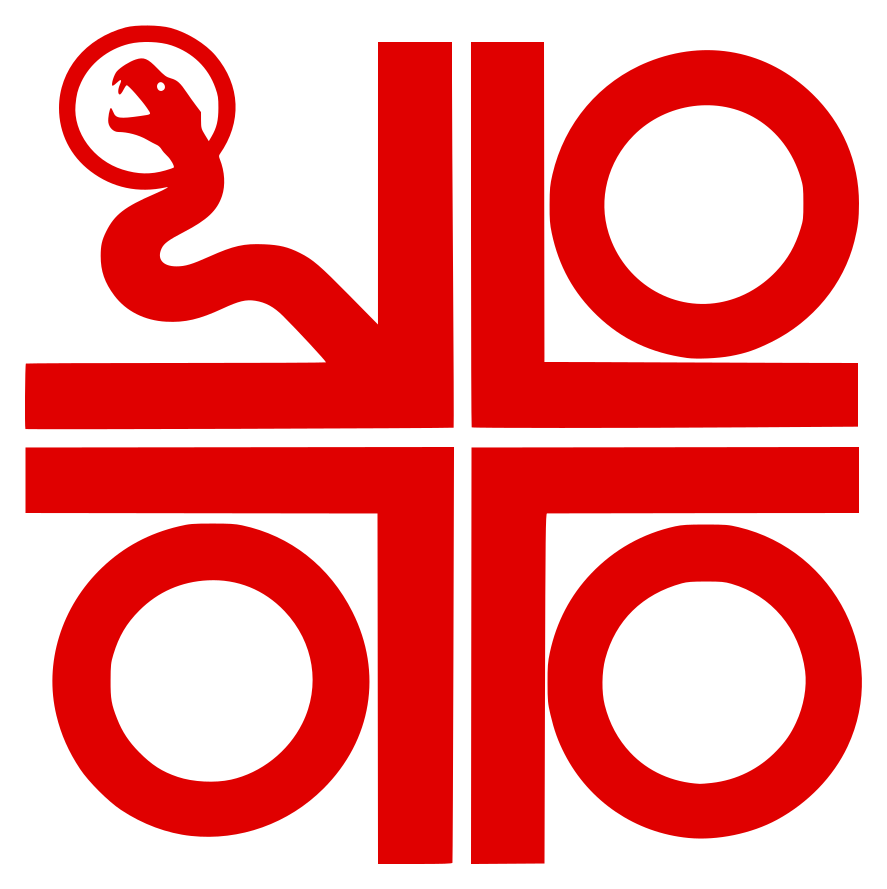
The equal-armed cross recalls Jesus’s crucifixion. Its serpent, crowned by a halo, recalls the bronze serpent Moses raised on a pole in the wilderness. Those bitten by venomous snakes could look upon it and live. Jesus connected this event with his own being lifted up; the serpent in our emblem therefore represents Jesus.
The three circles represent three coils of the serpent around the pole. Their triangular arrangement also evokes 888: imaginatively connecting each pair with a crossing forms three figure-eights. This motif recalls the numerical value of Ἰησοῦς, the Greek name Jesus: 10 + 8 + 200 + 70 + 400 + 200 = 888.
The red color represents the blood of Jesus and his sacrifice.
Form
Meet, greet, and eat.
We gather to enjoy friendship with people whose conduct honors Jesus, without performative religious obligations.
A generous brunch in a church home. Your host furnishes and prepares the meal; members generally bring nothing. Arrive, catch up, eat, unwind, and enjoy being together.
No scheduled sermon, congregational song service, corporate prayer, or worship leader. Neither the host nor the priest has a prescribed speaking role. Faith and ordinary life are welcome topics of conversation among friends.
Our planned free teaching library will offer written teachings, podcasts, videos, concordances, and a biblical encyclopedia to members and nonmembers. Bring questions to your host and explore them with friends. Resources will appear here as they become available.
A holiday such as Christmas may have a distinct form, perhaps with singing or a sermon-like contribution.
04 / Registry
Membership registration is coming soon. Once it opens, apply for membership and connect with the people who share your community.
Registration coming soonCreate your profile and submit your membership application.
Applicants affirm the Accords of Anathema before approved membership. Directory access begins after church approval; admission to a local group also requires that group’s vote.
Contact details are available within your local group and the interest groups you join. Wider neighborhood discovery shows general profiles only.
05 / Community
Stay in touch. Find a shared interest.
Make plans to meet again.
Local groups grow primarily through friendship and word of mouth. Hosts volunteer and invite people they know or meet. Immediate families typically join together, within the group’s size cap.
Every admission requires a group vote. Hosts and members have equal votes. Under our rule of two witnesses, any two members voting against admission block it; one objection alone does not. All votes are anonymous, so members can express their judgment without pressure.
A group may also vote to remove a member. The group cap, voting eligibility, and removal procedure are still being established.
Get to know your group and host, with relevant contact information close at hand.
Join groups that bring members together across local church homes.
Connect with friends, exchange private messages, and arrange group meetings.
06 / Calendar
Brunches, shared interests,
and the next reason to gather.
The member calendar will open with the community area. Public gathering dates have not yet been announced.
Member calendar coming soon